
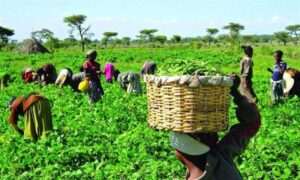
 Farmers in Nasarawa State have appealed to the Federal Government to adopt the climate smart agricultural model introduced by the Sasakawa Africa Association (SAA), describing it as key to achieving food security in the country.
The farmers, under the umbrella of cooperative societies, made the appeal during a media field tour of SAA project sites in Lafia, Obi and Doma local government areas of Nasarawa.
They said, with the Federal Government’s support, the model, which has transformed farming in their communities, could be replicated nationwide to cushion the effects of climate change and boost food production.
In Tudun Adabu and Angwan Hamidu communities in Obi Local Government Area, where SAA established soybean/maize intercropping and pro-vitamin demonstration plots, the farmers said the intervention had proven that improved methods work better than traditional practices.
Chairman, Ayinewoza Careers Group, Ogbole Bashir, who lauded the resilience of the improved seeds distribution by SAA against harsh weather conditions, called on the government to intervene.
“What we are seeing here is different from our local methods, they taught us to plant at 75 centimetres spacing, unlike before when we planted without measurement. We have not even harvested, but the difference is clear, if the Federal Government can support this model and give us more of these seeds and training, Nigeria will not have a good problem,” he said
Another beneficiary, Jibrin Elayo, appealed for government’s investments in extension services to teach farmers the new technologies.
“Before now, you hardly found a farmer planting one seed of maize per hole. We thought it would not germinate. Now we plant one seed per hole at 25 centimetres between stands, and we do four-by-four rotation between maize and soybean. This is new to us, and we are seeing results in moisture retention, we need government to help us take this knowledge to every farmer,” he said.
In Doma Local Government Area, women farmers also joined the appeal. At Madagba watta, Mrs Felicia Alaku, the leader of a women group cultivating Orange Fleshed Sweet Potato (OFSP), said the crop has improved both nutrition and income but needs government support to reach more women.
“They didn’t just give us the vine, they taught us how to process it into porridge, juice and fries for our children, and how to store it. It is rich in vitamin A. We are appealing to government to help us expand this, because it can reduce hunger in many homes,’’ she said.
The farmers noted that the early maturing nature of the improved varieties allows them to farm the same land twice a year – a practice that could double national food output of adopted.
The Permanent Secretary, Ministry of Agriculture and Food Security, Hajiya Salamatu Oseze, who responded to the call of the farmers welcomed the partnership between SAA and Nasarawa Agricultural Development Programme (NADP), noting that the testimonies from farmers have been outstanding.
At the Collage of Agriculture, Science and Technology, Lafia, Dr William Akaamaa, Coordinator of the family business graden established by SAA, said the Federal Government should promote backyard vegetable farming as a potent tool against food insecurity.
Earlier, the Country Director of SAA, Dr Godwin Atser, represented by the Technical Coordinator for Climate Resilience and Agrifood System, Nathaniel Otene, said SAA’s interventions are focused on linking productivity to income.
He called for increased government’s investments in agricultural research, extension services, digital agriculture and youth participation.
“We live in a time when climate change is affecting the entire agricultural production system. Innovations from research institutions will have limited impact unless they are effectively transferred to farmers” he said.
The farmers added that with sustained Federal Government’s funding, the Sasakawa model could be replicated across the 36 states to feed the nation.